
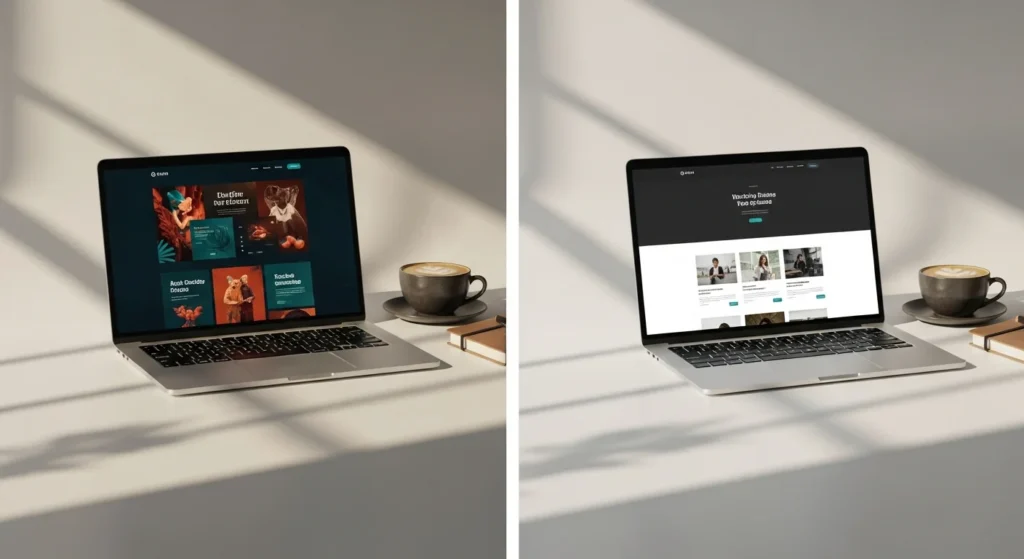
A friend of mine launched her bakery’s website last year using a popular template. It looked gorgeous — soft pastels, clean fonts, beautiful stock photos of croissants she didn’t actually bake. Three months later, she called me in a mild panic. She wanted to add online ordering, integrate with her local delivery service, and let customers customize cakes through an interactive form. The template couldn’t do any of it. She’d spent $800 on a design she now had to abandon. That conversation stuck with me because it perfectly captures the tension most business owners face when building their online presence.
So let’s talk about it honestly: should you go custom, or should you grab a template and run with it?
The Allure of Templates (and Why It’s Mostly Justified)
Templates exist for a very good reason. They’re fast, they’re affordable, and modern ones actually look fantastic. Platforms like Squarespace, Wix, and WordPress theme marketplaces offer thousands of polished designs that you can launch in a weekend. For somewhere between $0 and $200, you get a professional-looking site without writing a single line of code. That’s genuinely remarkable when you think about where web design was even ten years ago.
If you’re a freelance photographer who needs a portfolio, a consultant putting up a simple five-page site, or a startup testing a concept before committing real resources — templates are not just acceptable, they’re smart. You don’t need a Ferrari to drive to the grocery store. There’s no shame in choosing the practical option, and anyone who tells you otherwise is probably trying to sell you something expensive.
But here’s the thing people don’t talk about enough. Templates are designed to serve everyone, which means they’re optimized for no one in particular. That gorgeous layout you picked? Roughly 47,000 other websites are wearing the same outfit. The structure, the user flow, the way information is organized — it was all built around assumptions about a generic business, not yours. And those assumptions start to crack the moment your needs get even slightly specific.
When a Custom Website Becomes the Only Real Option
Let me paint a scenario. You run a growing e-commerce brand selling handmade ceramics. You need a product filtering system that sorts by glaze type, firing method, and size. You want a “build your own set” feature where customers mix and match pieces. Your shipping calculations are complex because fragile pottery costs different amounts to ship depending on the combination of items. Try doing that with a drag-and-drop builder. You’ll age five years in a week.
A custom website isn’t just about aesthetics — it’s about architecture. It’s built around your specific workflows, your customers’ actual behavior, and your business logic. Every button, every page transition, every database query is intentional. That level of precision is something no pre-built theme can deliver, no matter how many plugins you stack on top of it.
And this brings us to the conversation that really matters: cost vs value. Yes, custom development is more expensive upfront. A well-built custom site might run you anywhere from $5,000 to $50,000 depending on complexity. That number makes people flinch. But consider what you’re actually buying. You’re buying a tool that fits your business like a glove, converts visitors more effectively because the user experience was designed around real data, and doesn’t break when you need to evolve.
My bakery friend? She ended up spending $3,200 on a custom solution after wasting $800 on her template. If she’d gone custom from the start, she would’ve spent roughly the same total — and saved three months of lost online orders. The cheapest option and the most valuable option are rarely the same thing.
The Scalability Question Nobody Asks Early Enough
Here’s where I see the biggest mistakes happen. People choose based on where their business is today instead of where it’ll be in two years. Scalability isn’t a buzzword — it’s the difference between a website that grows with you and one that becomes a bottleneck.
Templates tend to hit walls. You add too many plugins and the site slows to a crawl. You need a membership portal and the theme doesn’t support it cleanly. You want to integrate with a CRM or an inventory management system and suddenly you’re hacking together workarounds that feel held together with duct tape. Each workaround adds technical debt, and eventually the whole thing becomes fragile and frustrating to maintain.
Custom-built sites, when done well, are designed with scalability baked into their foundation. Need to add a new product line? The architecture supports it. Want to expand into a new market with multilingual content? It was planned for. That upfront investment in thoughtful development pays compound interest over time.
But — and this is crucial — custom only wins if you actually need that flexibility. If your business model is straightforward and unlikely to change dramatically, you’d be over-engineering the problem. That’s just as wasteful as under-building.
So Which One Should You Actually Pick?
Strip away all the marketing noise and it comes down to one honest question: how complex are your needs, and how fast are they likely to change?
If you need a clean online presence with standard pages, a blog, and maybe a contact form — grab a well-designed template, invest your money in great copywriting and photography instead, and move on with your life. You’ll be live in days, not months.
If your website is your product — if it needs to handle transactions, user accounts, complex integrations, or unique functionality — a custom website isn’t a luxury. It’s infrastructure. Treat it like one.
The worst decision isn’t choosing templates or choosing custom. It’s choosing without thinking about where you’re headed. Take thirty minutes, map out what your site needs to do in twelve months, and let that roadmap guide you. Your future self — the one who won’t have to rebuild everything from scratch — will thank you.